
Toilet Hissing After Flushing? Here's Why

Why does my toilet make a hissing sound after flushing?
Read full question
Nobody ever told me how many weird sounds a toilet could make — I just assumed they flushed and that was it. But ours has started making this soft, almost constant hissing noise after every flush, and it seems to go on for a while before it finally stops. I can hear it from the hallway, which feels embarrassing when we have guests over.
I'm probably missing something super obvious here, but I genuinely have no idea if this is a water pressure thing, an air thing, or just the toilet being old. The house is a few years old and I don't think the toilet has ever been serviced. Is this something I should be worried about, or is it just a minor annoyance I can fix myself?
Quick Answer
A hissing toilet is almost always caused by a failing fill valve that's struggling to shut off cleanly, or a worn flapper allowing water to slowly leak into the bowl and keeping the fill valve running. Both are common, inexpensive repairs you can handle yourself with basic tools.
First, a Reassurance — Then a Safety Note
This is not a dumb question at all. A hissing toilet is one of the most commonly reported plumbing annoyances, and it's worth addressing promptly. A toilet that hisses and then continues running — or never fully goes quiet — is often wasting water around the clock, which adds up on your water bill. Diagnosing the cause is worthwhile even if the sound seems minor.
Before you open the tank, there are a couple of safety basics to keep in mind. The water inside a toilet tank is clean supply water — not sewage — so you don't need to worry about contamination from opening the lid. That said, always turn off the supply at the shutoff valve (the oval or football-shaped valve on the wall behind or beside the base of the toilet) before you remove or adjust any internal parts. Flush once to drain most of the water, then use a sponge or towel to soak up whatever remains so you're not working in a puddle. Porcelain tanks chip and crack if tools are dropped or lids are set down carelessly, so place the lid flat on a towel on the floor — not balanced on the edge of the tank.
What's Actually Causing That Hiss
The sound you're hearing is pressurized water moving through a component that isn't sealing properly. There are two main culprits, and figuring out which one you have is straightforward.
1. A Worn or Failing Fill Valve
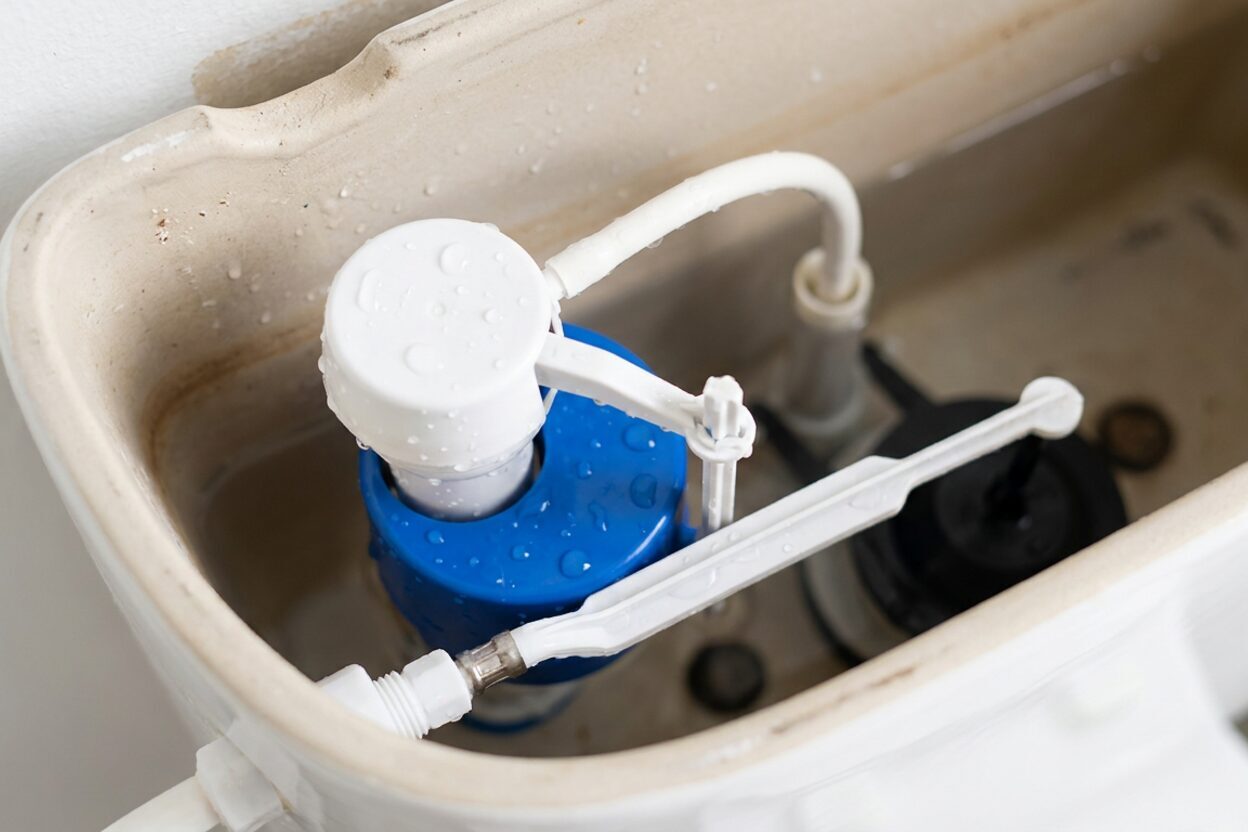
The fill valve is the tall mechanism on the left side of your tank. Its job is to refill the tank after a flush and then shut off completely once the water reaches the correct level. Over time — and the timeline varies a lot depending on your local water chemistry and mineral content — the internal seals and diaphragm inside the fill valve wear down. When they do, the valve struggles to close tightly, and water keeps trying to push through that weakened seal. That's your hiss.
To test this, lift the float arm or float cup up by hand while the toilet is refilling. If the hissing stops immediately when you push the float up, the fill valve is the issue. It's either set too low (so the float never tells it to shut off), or the valve itself is worn out and needs replacement.
2. A Leaking Flapper
The flapper is the rubber seal at the bottom of the tank that covers the flush valve opening. When it wears out, warps, or gets coated with mineral deposits, it no longer forms a perfect seal. Water slowly seeps from the tank into the bowl — often completely silently — and the fill valve responds by running continuously to keep the tank topped up. That continuous refilling is what produces the hissing sound.
A quick test: put a few drops of food coloring into the tank and don't flush for 10–15 minutes. If color appears in the bowl without flushing, your flapper is leaking. This is the classic "phantom flush" or running toilet symptom, and it's extremely common. You can find more on related issues in our guides on flappers and flush handles.
3. High Water Pressure (Less Common)
Occasionally, unusually high household water pressure can cause a fill valve to hiss even when the valve itself is in decent condition. If you suspect high water pressure, a plumber or home inspector can check it with a pressure gauge at an outdoor hose bib. Normal residential supply pressure falls within a range your plumber can advise on; if yours is outside that range, a pressure-reducing valve (PRV) adjustment or replacement is the typical remedy. This is less common than a worn fill valve or flapper, but worth knowing about.
What You'll Need
- Replacement fill valve (most modern fill valves are adjustable and fit a wide range of toilets, but bring your toilet's make and model or a photo of the old valve to confirm)
- Replacement flapper (flappers are available in 2-inch and 3-inch sizes to match your flush valve opening — measure the opening or note the toilet model before buying, as installing the wrong diameter will cause leaks)
- Adjustable wrench or channel-lock pliers
- Sponge and a bucket or old towel
- Food coloring (for the flapper test)
The Fix: Fill Valve Replacement
- Shut off the supply valve, flush to empty the tank, and sponge out the remaining water.
- Disconnect the supply line from the bottom of the fill valve (have a small towel ready for drips).
- Unscrew the locknut at the base of the fill valve — usually hand-tightened or needing light use of pliers — and lift the old valve out.
- Set the new fill valve to the correct height per the manufacturer's instructions (there's typically a twist-to-adjust collar). Before locking it in place, confirm that the fill valve's critical-level (CL) mark — usually a molded arrow or label on the valve body — sits at or above the top of the overflow tube. Only the water level itself should be set below the overflow tube top (typically about an inch below). If the CL mark ends up below the overflow tube top after installation, raise the valve per the manufacturer's instructions before proceeding.
- Insert, tighten the locknut — snug plus about a quarter turn; do not overtighten against porcelain — and reconnect the supply line.
- Turn the water back on slowly, check for drips at the connection, and adjust the fill height so the water stops about an inch below the top of the overflow tube.
The Fix: Flapper Replacement
- Shut off the supply valve and flush to drain the tank.
- Unhook the old flapper from the ears on the overflow tube and disconnect the chain from the flush handle arm.
- Snap the new flapper onto the overflow tube ears and reconnect the chain. Leave just enough slack that the flapper sits flat and fully sealed when the handle is at rest, but can lift completely when the handle is pressed. Too much slack and the chain can get caught under the flapper; too little and the flapper won't seal. Adjust by trial and error — flush a few times and watch to confirm the flapper drops fully closed each time.
- Turn the water back on, allow the tank to fill, and repeat the food-coloring test to confirm the new flapper seals.
Both repairs are well within DIY territory for a first-time homeowner, and replacement fill valves and flappers are widely available at any hardware store. If you replace both and the hissing continues, it's worth checking whether the water pressure in your home is unusually high — that's a good conversation to have with a licensed plumber. You can also browse our toilet repair guides for related troubleshooting if you run into anything unexpected along the way.
 Fluidmaster 400H-002 Performax Universal Toilet Fill Valve High Performance Tank and Bowl Water Control, 1-Pack, Multicolor
View on Amazon →
Fluidmaster 400H-002 Performax Universal Toilet Fill Valve High Performance Tank and Bowl Water Control, 1-Pack, Multicolor
View on Amazon →
 Korky 2017BP Standard 2-Inch 2X Ultra High Performance Universal Long Lasting Rubber-Easy to Install-Made in USA Toilet Flapper, 1 Count (Pack of 1), Red
View on Amazon →
Korky 2017BP Standard 2-Inch 2X Ultra High Performance Universal Long Lasting Rubber-Easy to Install-Made in USA Toilet Flapper, 1 Count (Pack of 1), Red
View on Amazon →
 Toilet Fill Cycle Diverters overflow & Leak Detecting Dye-Tablets Tank Water Saver Pack, 2 Pack
View on Amazon →
Toilet Fill Cycle Diverters overflow & Leak Detecting Dye-Tablets Tank Water Saver Pack, 2 Pack
View on Amazon →

Still need help? Ask a Plumbing Expert AD
Get a personalized answer from a verified plumbing expert. Describe your issue and get step-by-step help.