
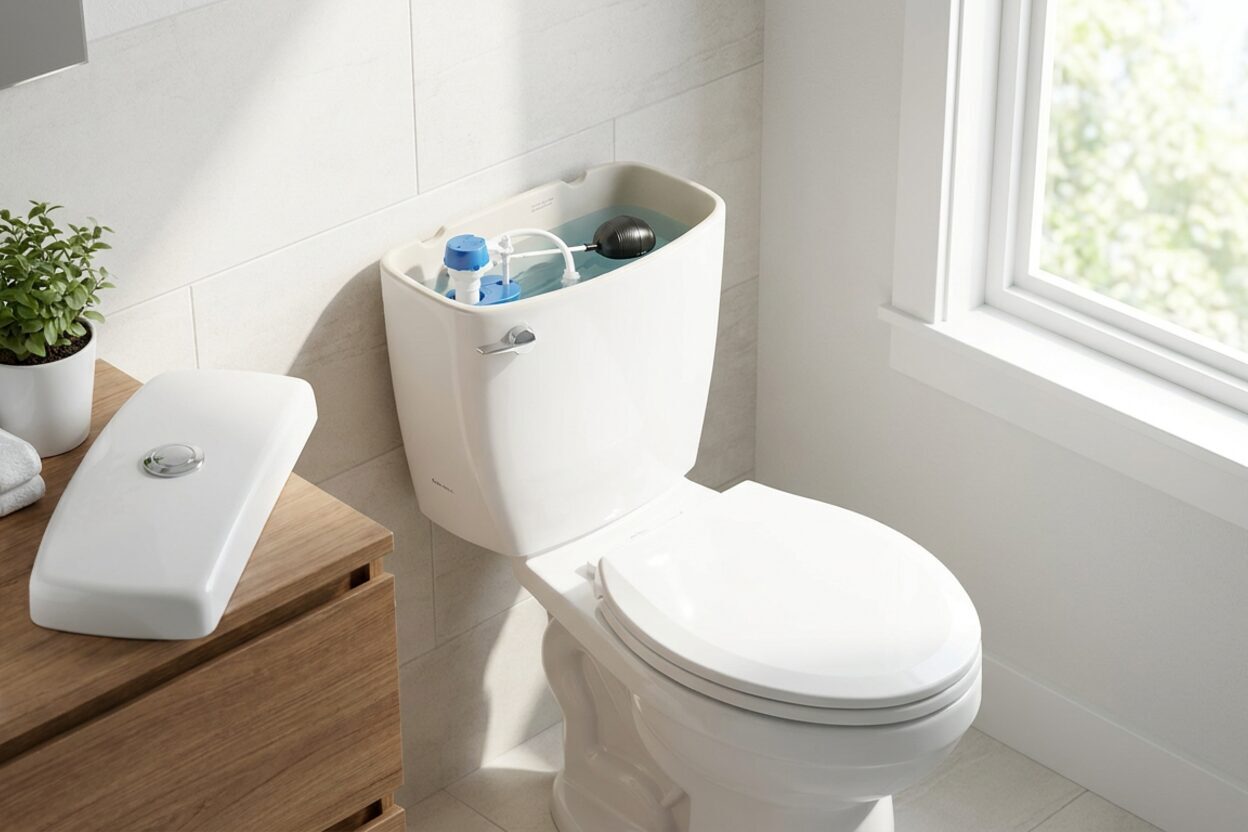
Why Your Toilet Keeps Running — and How to Stop It
Quick Answer
A complete walkthrough of every reason a toilet runs — flapper, fill valve, float, chain, and overflow — with the food-coloring test to pinpoint the cause and the fix for each.
The short version
A toilet that runs, hisses, or refills on its own is wasting water 24 hours a day, and the culprit is nearly always one of two parts inside the tank: the flapper (the rubber seal at the bottom) or the fill valve (the tower that refills the tank). The good news is both are inexpensive, sold at any hardware store, and replaceable in under half an hour with no special skills.
Before you buy anything, take the tank lid off, set it flat somewhere safe (it's heavy porcelain and cracks easily), and watch a flush. Most of the time the problem shows itself.
Step 1: Do the dye test to find the leak
This one test tells you which half of the tank is at fault. Put a few drops of food coloring into the tank water and wait 10–15 minutes without flushing. Then look in the bowl:
- Color seeps into the bowl → water is escaping past the flapper. The flapper (or the seat it sits on) is your problem. Go to Step 2.
- Bowl stays clear but you still hear running or trickling → the fill valve is letting water into the overflow tube. Go to Step 3.
We walk through this in more depth in Why Is My Toilet Always Running?
Step 2: The flapper (most common cause)
The flapper is a rubber flap that lifts to flush and drops to seal. Over a few years it hardens, warps, or gets a film of mineral scale, and it stops sealing. Water then trickles from tank to bowl, the level drops, and the fill valve kicks on every so often to top it up — the classic "phantom flush" every few minutes or hours.
What to check
- The flapper itself. Run a finger around the sealing edge. If it's stiff, slimy, or cracked, replace it. Take the old one to the store to match the size (most are 2 inch; higher-capacity toilets use 3 inch).
- The chain. Too tight and it holds the flapper open a hair; too loose and it tangles under the flapper. You want a tiny bit of slack when closed.
- The seat. If a new flapper still leaks, run your finger around the plastic rim it seals against. A pitted or scaled seat will chew through flappers — clean it, or fit a seat-repair kit.
Step-by-step in How to Stop a Running Toilet for Good.
Step 3: The fill valve and water level
If the dye test kept the bowl clear, water is going into the overflow tube — the open vertical pipe in the middle of the tank. That means the water level is set too high, or the fill valve won't shut all the way off.
- Level too high: the water should sit about an inch below the top of the overflow tube. Lower the float (a screw or clip on modern valves) until it shuts off there. See How to Adjust Toilet Tank Water Level.
- Valve won't stop: if lowering the float doesn't stop the trickle, the valve's internal seal is worn. Replacing the whole fill valve is one of the easiest toilet repairs — turn off the supply, flush to drain, and swap it. Full walkthrough: How to Replace a Toilet Fill Valve and Why Does My Toilet Fill Valve Keep Running?
Before you open anything up
Any time you're removing a part rather than just adjusting it, turn off the supply valve at the wall behind the toilet and flush to empty the tank first. Sponge out the last inch of water so you're not working in a full tank.
When it's worth calling a plumber
Running-toilet fixes are firmly DIY. The rare exception is if you've replaced both the flapper and the fill valve and it still runs — that can point to a warped flush valve (the whole drain assembly), which means pulling the tank off the bowl. That's still doable at home, but it's the point where many people decide a plumber's hour is worth it.
Frequently asked
How much water does a running toilet waste?
A lot — a steadily running toilet can waste hundreds of gallons a day, which is why it's worth fixing the week you notice it rather than "getting to it eventually."
My toilet only runs for a few seconds every so often. Is that still a problem?
Yes. That intermittent top-up is the phantom-flush symptom of a flapper leaking slowly. The dye test in Step 1 will confirm it. See Why Does My Toilet Keep Filling With Water?
 Korky 2017BP Standard 2-Inch 2X Ultra High Performance Universal Long Lasting Rubber-Easy to Install-Made in USA Toilet Flapper, 1 Count (Pack of 1), Red
View on Amazon →
Korky 2017BP Standard 2-Inch 2X Ultra High Performance Universal Long Lasting Rubber-Easy to Install-Made in USA Toilet Flapper, 1 Count (Pack of 1), Red
View on Amazon →
 Toilet Flapper Chain, Stainless Steel Toilet Handle Chain, 2 Pack Toilet Flapper Chain Replacement Kit 9.45'' Universal Toilet Chain Toilet Flush Lift Chain Adjustable Length Fits Most Toilet Flappers
View on Amazon →
Toilet Flapper Chain, Stainless Steel Toilet Handle Chain, 2 Pack Toilet Flapper Chain Replacement Kit 9.45'' Universal Toilet Chain Toilet Flush Lift Chain Adjustable Length Fits Most Toilet Flappers
View on Amazon →
 Toilet Fill Cycle Diverters overflow & Leak Detecting Dye-Tablets Tank Water Saver Pack, 2 Pack
View on Amazon →
Toilet Fill Cycle Diverters overflow & Leak Detecting Dye-Tablets Tank Water Saver Pack, 2 Pack
View on Amazon →
 Fluidmaster 400H-002 Performax Universal Toilet Fill Valve High Performance Tank and Bowl Water Control, 1-Pack, Multicolor
View on Amazon →
Fluidmaster 400H-002 Performax Universal Toilet Fill Valve High Performance Tank and Bowl Water Control, 1-Pack, Multicolor
View on Amazon →

Still need help? Ask a Plumbing Expert AD
Get a personalized answer from a verified plumbing expert. Describe your issue and get step-by-step help.