
Toilet Leaks at Base Only When Flushed: Why & Fix

Toilet Only Leaks at the Base During a Flush — Warranty Issue?
Read full question
Three weeks ago I started noticing a small puddle of water forming right at the base of our main bathroom toilet, but only after someone flushes it — not any other time. Between flushes the floor stays completely dry, which seems strange to me. I've owned this house for a few years and never had a problem with this toilet before.
Before I start tearing into this and potentially voiding something, I wanted to ask: would a repair like this fall under any kind of manufacturer warranty, or is this considered normal wear and tear? The toilet itself isn't that old, and I'd hate to pull it and reseat it if there's coverage I'm not aware of.
Also, we do have fairly hard water in this area — not sure if mineral buildup could somehow be contributing to the seal breaking down faster than normal. Any guidance on what's actually causing this and where to start would be really appreciated.
Quick Answer
A toilet that leaks at the base only during flushing almost always points to a failed or compromised wax ring seal, loose closet bolts, or a cracked horn — because the surge of water pressure during a flush is what exposes those weak points. Rule out simpler causes first (loose bolts, tank-to-bowl connection) before pulling the toilet. A full reseat with a new wax ring is the definitive fix if the seal has failed.
First, a Quick Note on Warranty
Most toilet manufacturers warrant the porcelain fixture itself against defects for a defined period — check your toilet's paperwork or the brand's website for specifics, since terms vary widely. What warranty coverage generally does not include is wear-and-tear on consumable components like the wax ring, which sits between the toilet and the flange in the floor and is considered a plumber-supplied installation part rather than a manufacturer component. So practically speaking, a base leak caused by a failed wax ring or loose hardware is typically a homeowner repair, not a warranty claim. That said, if the bowl itself is cracked, that could be a different conversation with the manufacturer.
Now, on to the actual diagnosis — because the pattern you're describing is a useful clue.
Why the "Only During a Flush" Detail Matters
The timing is actually the most diagnostic thing you've given here. A constant, steady leak at the base — present even between flushes — usually points to condensation (sweating tank), a supply line drip running down to the floor, or a crack in the bowl. A leak that appears only when the toilet is flushed is different: it means something is failing under pressure or volume surge, then sealing back up once things settle. That narrows the suspects considerably. Work through these scenarios in order before reaching for a wrench.
Scenario 1: Loose Closet Bolts (Start Here)
The closet bolts — the two bolts at the base of the toilet, usually hidden under plastic caps — anchor the toilet to the flange in the floor. If these work loose over time, the toilet rocks even slightly during a flush, and that movement breaks the wax seal temporarily, allowing water to escape at the base. This is one of the more common causes of exactly the symptom you're describing.
How to check: Try gently rocking the toilet from side to side. Any perceptible movement at all is a red flag. Pry off the plastic bolt caps, and if the nuts are loose, try snugging them down — hand-tight, then snug a little further by feel — stop as soon as resistance builds. Porcelain bases and flanges can crack under excess force, so err on the side of less. Flush a few times and watch for the leak. If the bolts were clearly loose and tightening them stops the leak, you may have gotten lucky. If the toilet still leaks, or if the wax seal was already compromised by the movement, you'll likely need to reseat.
Scenario 2: A Failing Wax Ring
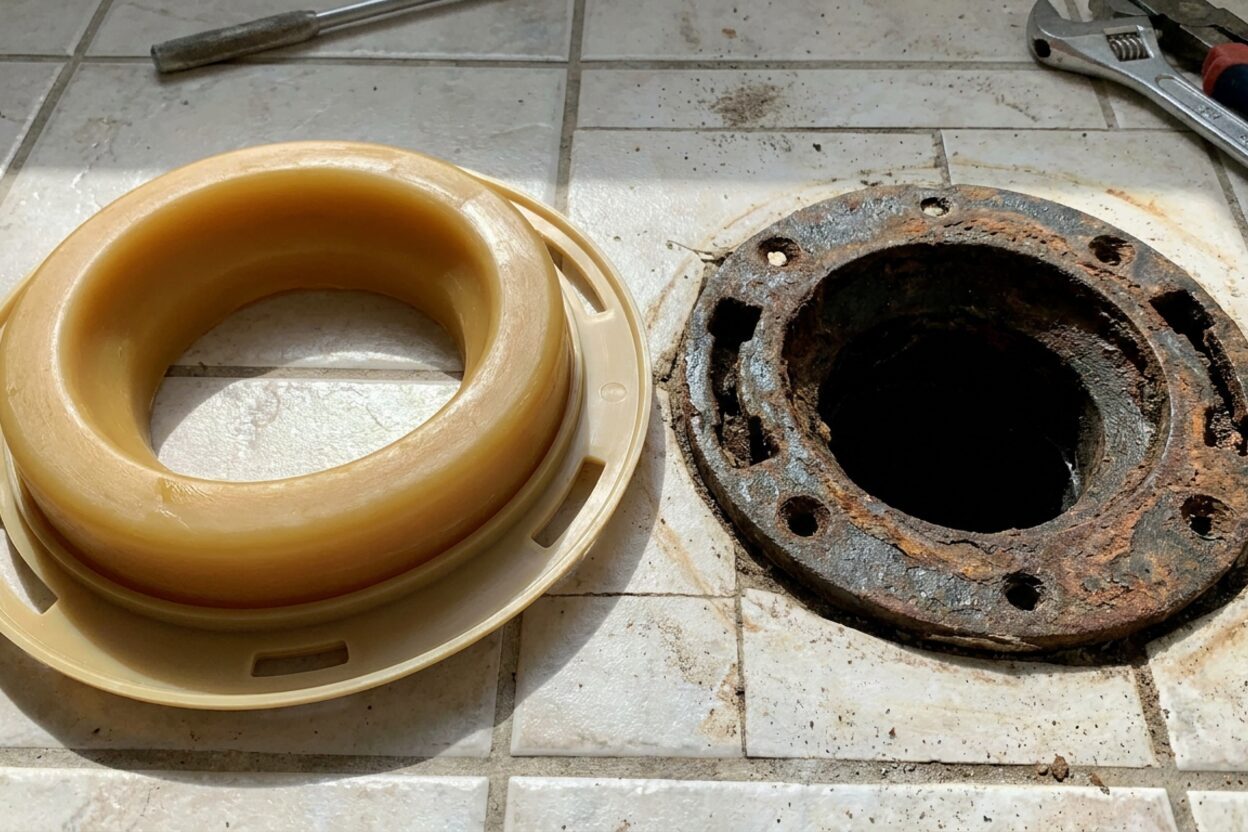
The wax ring creates a watertight seal between the bottom of the toilet horn (the outlet opening) and the closet flange in the floor. Over time — and the timeline varies with water chemistry, use, and whether the toilet has ever rocked — the wax can compress, crack, or shift enough that it no longer seals under the surge of a full flush. Hard water on its own doesn't directly degrade the wax, but mineral buildup inside the horn or on the flange can affect how evenly the toilet sits, which in turn stresses the seal.
A failed wax ring won't fix itself. The only reliable repair is pulling the toilet and installing a fresh ring. This is a medium-difficulty DIY job — you'll want a helper for the lift — and the steps are:
- Shut off the supply valve (angle stop) at the wall.
- Flush to empty the tank, then sponge out any remaining water from both tank and bowl.
- Disconnect the supply line at the base of the tank.
- Unscrew the closet bolt nuts, remove the bolt caps, and have a helper for this step — a toilet is heavy (often 60–120 lbs) and awkward to carry alone. Lift with your legs, not your back, and set it aside on cardboard or old towels to protect the floor and the fixture.
- Scrape the old wax from both the flange and the toilet horn with a putty knife — get it clean.
- Inspect the flange carefully (see the note below on flanges).
- Press a new wax ring onto the toilet horn (horn-side down), lower the toilet straight down onto the bolts, and press firmly into place — your body weight is appropriate here, seat and rock gently.
- Snug the nuts down evenly, alternating sides — hand-tight, then just a little more by feel. Stop the moment you feel resistance; porcelain bases crack easily under excess force. Check your toilet manufacturer's instructions if available.
- Reconnect the supply line, turn the water back on, and flush several times while watching the base.
For more guidance on this repair, see our resources on wax ring and flange repairs.
Scenario 3: Check the Flange Condition Before You Reseat
When you pull the toilet, take a close look at the closet flange — the ring set into the floor that the toilet bolts to. A cracked flange, a flange that sits below the finished floor level, or one where the slots are broken off (so the closet bolts won't hold) is a situation where simply dropping a new wax ring won't solve the problem long-term. A flange sitting too low, for example, means the wax ring can't compress and seal correctly.
When to call a plumber: If the flange is broken, sitting noticeably below floor level, or you're dealing with an older cast-iron or lead bend, that's a call-a-plumber situation. Flange repairs that involve cutting into the drain line or working with older materials are outside the scope of a typical DIY reseat.
Scenario 4: Could It Be a Cracked Bowl?
Less common, but worth a look: hairline cracks in the porcelain at the base of the bowl can leak under the pressure of a flush and then appear dry afterward as the water wicks away. Run your hand around the entire base of the toilet, both outside and inside the bowl near the bottom, after drying it thoroughly. If you find a crack, the bowl needs to be replaced — cracks in porcelain don't seal reliably, and this is a call-a-plumber-or-replace-the-toilet situation depending on your comfort level.
A Note on Caulking the Base
Once you've completed a reseat, you'll face a choice: some local plumbing codes require caulking the toilet to the floor — check your local authority having jurisdiction (AHJ) or ask your permit office, since requirements vary. On the other hand, some experienced plumbers deliberately leave the back of the base uncaulked so that any future wax-ring failure shows up as a visible puddle on the floor rather than seeping silently under the tile. Both positions have merit — I'd suggest checking your local code first, and if it's required, caulk all the way around; if it's not required, leaving a gap at the rear gives you an early warning system.
Tools and Parts You'll Need
- Adjustable wrench or channel-lock pliers
- Putty knife or scraper
- New wax ring (standard, or extra-thick only if the flange is just slightly — a few millimeters — below finished floor level; see Scenario 3 for when a low flange requires a plumber instead)
- Replacement closet bolt set (recommended any time you reseat)
- Bucket and sponge
- Old towels or cardboard to protect the floor
- Rubber gloves
- Utility knife and silicone caulk (if caulking after)
If you work through the scenarios above in order — bolts first, then reseat if needed — you should be able to pinpoint the cause without unnecessary teardown. The full reseat is well within reach for a confident DIYer, but don't hesitate to call a licensed plumber if the flange turns out to be the problem, or if anything looks more involved once the toilet is off the floor.
 Oatey Fix-It Stainless Steel Flange Repair Ring, Adjustable Toilet Flange Repair Kit for Broken or Cracked Mounting Flanges, Secure Seal
View on Amazon →
Oatey Fix-It Stainless Steel Flange Repair Ring, Adjustable Toilet Flange Repair Kit for Broken or Cracked Mounting Flanges, Secure Seal
View on Amazon →
 Fluidmaster 7511 Toilet Wax Ring with Flange and Bolts
View on Amazon →
Fluidmaster 7511 Toilet Wax Ring with Flange and Bolts
View on Amazon →

Still need help? Ask a Plumbing Expert AD
Get a personalized answer from a verified plumbing expert. Describe your issue and get step-by-step help.