
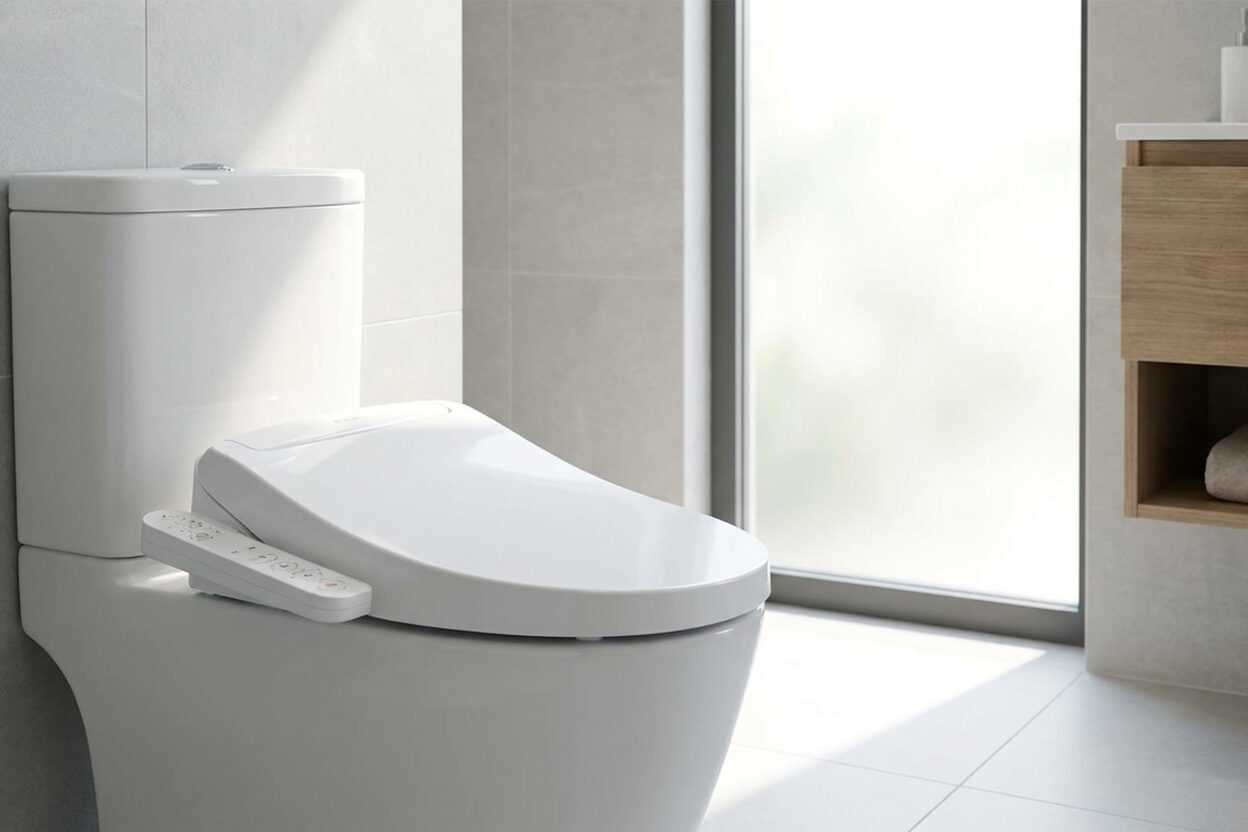
Does a Bidet Seat Need Its Own Outlet?

Do I Need a Dedicated Outlet Before Buying a Bidet Seat?
Read full question
Found a bidet seat I really like — it has a heated seat, warm-water wash, and a warm-air dryer — but now I'm second-guessing whether my bathroom is even wired for it. The only outlet in that bathroom is on the wall beside the vanity mirror, which is a good four or five feet from the toilet. I don't want to buy something and then find out I need a major electrical project just to plug it in.
Is a standard bathroom outlet enough, or does a bidet seat need its own dedicated circuit? And is it a problem that mine is GFCI-protected — does that interfere with anything? Would love to know what to look for before I pull the trigger on this purchase.
Quick Answer
Most electric bidet seats run fine on an existing shared bathroom circuit — no dedicated circuit required in the majority of homes. You do need a nearby 120-volt GFCI-protected outlet, which is actually the standard outlet type already required in bathrooms by code. Non-electric bidet seats skip the outlet question entirely but give up heated water and dryer functions.
First, Let's Figure Out What Your Bathroom Actually Has
Before worrying about whether you need new wiring, it's worth verifying a couple of things about your current setup. Walk to your bathroom outlet and look for the small TEST and RESET buttons on its face — that's a GFCI outlet, and it's exactly what bidet seat manufacturers require. TOTO, for example, explicitly calls for a GFCI outlet near the toilet for all of their WASHLET seats. So if you already have one, that's good news, not a problem.
The remaining question is distance. Manufacturers generally want the outlet close enough that the seat's own power cord reaches comfortably without being stretched. Cord lengths vary by model, so check the spec sheet for your specific seat before assuming your outlet location will work — but we'll get to that.
Do You Need a Dedicated Circuit?
In most existing homes, no. Electric bidet seats are generally designed to share the bathroom's existing circuit. A tank-type heated seat (the most common kind) typically draws somewhere in the range of 400–600 watts during normal use, though the actual figure varies by model — check your seat's spec sheet for the precise rating. That's comparable to a hair dryer running on low — meaningful, but well within what a standard 15-amp bathroom circuit can handle alongside typical bathroom loads.
Tankless or "on-demand" heater models are the exception worth noting. These can spike to 1,200 watts or more — sometimes considerably higher depending on the model — at the moment hot water is called for. Check your specific seat's rated wattage in the product specifications. On a circuit that's already carrying a lot — a bathroom heater, high-wattage lighting, and a hair dryer all at once — that spike might cause a light flicker or even trip a breaker. In practice, most people don't run all those loads simultaneously, so it tends to be fine, but it's something to think about if your bathroom circuit already feels stressed.
For new construction or major renovation, many bidet seat manufacturers recommend specifying a dedicated 20-amp GFCI-protected circuit near the toilet. Check the specific seat manufacturer's installation requirements and consult your local code authority, since electrical code varies by jurisdiction.
What About the Outlet Location?
This is the practical sticking point for a lot of homeowners. The ideal setup is a GFCI outlet positioned directly behind or beside the toilet — close enough that the seat's cord reaches comfortably. If yours is near the vanity and the cord comes up short, you have a few options:
- Have an electrician add an outlet behind the toilet. This is the cleanest long-term solution and isn't necessarily a big job, especially if there's an adjacent wall cavity. An outlet installed this way stays hidden and meets code.
- Check the cord length on the specific seat you're buying. Some manufacturers include a longer cord than others — worth confirming in the spec sheet before purchasing.
- Avoid extension cords. Manufacturers and electricians universally discourage using a standard extension cord for a bidet seat in a wet environment. If an extension cord is your only option, it's a sign that the outlet placement really needs to be addressed properly first.
The No-Outlet Alternative: Non-Electric Bidet Seats
If adding or relocating an outlet genuinely isn't in the cards right now, it's worth knowing that non-electric bidet seats and attachments exist and work without any wiring at all. Non-electric bidet seats and attachments from brands such as Tushy, Bio Bidet, and others operate entirely on water pressure. Check current offerings from reputable bidet manufacturers for non-electric models — they're widely available and straightforward to install.
The trade-off is real — a non-electric seat gives up the heated seat, warm-water wash, and air dryer that make electric models appealing in the first place. But it needs no outlet at all, installs in under half an hour, and works as a stopgap until an electrician can add a proper GFCI outlet behind the toilet. If the features you listed are the whole point, the better path is the electric seat plus a properly placed outlet.
 LUXE Bidet NEO 120 - Single Nozzle, Self-Cleaning, Non-Electric Bidet Attachment for Toilet Seat, Adjustable Water Pressure, Rear Wash (White)
View on Amazon →
LUXE Bidet NEO 120 - Single Nozzle, Self-Cleaning, Non-Electric Bidet Attachment for Toilet Seat, Adjustable Water Pressure, Rear Wash (White)
View on Amazon →
 Eastman 12 Inch Flexible Toilet Connector, 7/8 Inch Ballcock x 3/8 Inch Compression, Stainless Steel Braided Hose, 48088
View on Amazon →
Eastman 12 Inch Flexible Toilet Connector, 7/8 Inch Ballcock x 3/8 Inch Compression, Stainless Steel Braided Hose, 48088
View on Amazon →

Still need help? Ask a Plumbing Expert AD
Get a personalized answer from a verified plumbing expert. Describe your issue and get step-by-step help.