
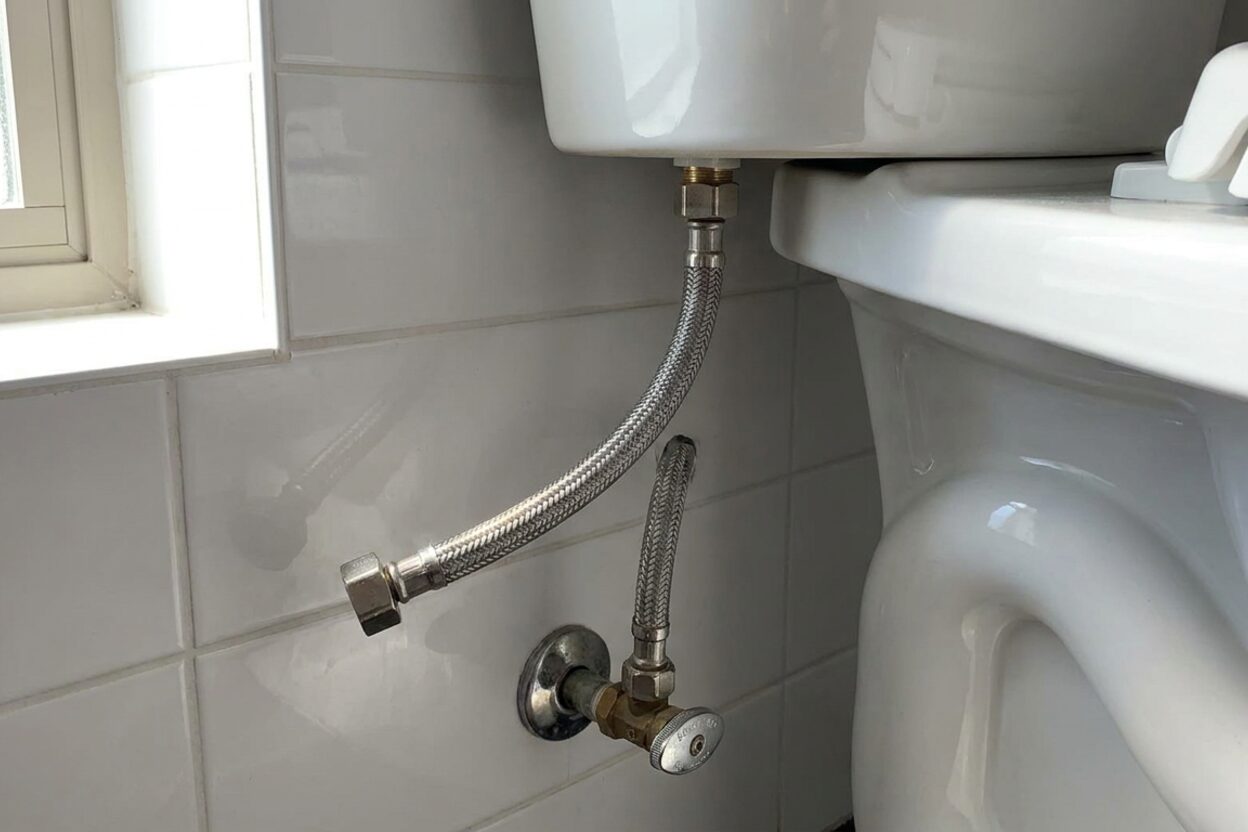
How to Shut Off Water to Just Your Toilet

Do I really need to shut off the whole house just to fix my toilet?
Read full question
During a conversation with a plumber who came out for a running toilet, he mentioned I'd need to shut off the main water supply to the house before doing anything. That seemed extreme to me — I've seen what looks like a small valve right behind the toilet near the floor, and I always assumed that was specifically for shutting off just the toilet without cutting water to the whole house. Am I wrong about that?
I'm trying to handle some of the simpler repairs myself now that I own this place, and I'd really like to understand how that little valve works and whether it's actually safe to rely on. The plumber made it sound like those valves are unreliable, but is that a reason to bypass it entirely, or is there a way to test it first?
Quick Answer
The small valve on the wall or floor behind your toilet — called an angle stop or supply shutoff valve — is specifically designed to cut water to just that toilet without affecting the rest of the house. Turn it clockwise until it stops, then flush to confirm the tank doesn't refill. If the valve is stuck, corroded, or leaks when you try to use it, that's when the main shutoff becomes necessary.
That Little Valve Behind Your Toilet Has One Job
Your instinct is correct. The valve tucked behind or beside the toilet — typically near the floor where the supply line meets the wall — is called an angle stop valve (sometimes just called a shutoff valve or supply stop). It exists precisely so you can isolate a single toilet for repairs without cutting water to the rest of your home. The plumber's caution likely wasn't that the valve can't work — it's that older or long-unused shutoff valves sometimes fail when you finally try to operate them. That's a maintenance reality worth understanding, not a reason to skip the valve entirely.
How the Angle Stop Actually Works
Inside the valve body, a stem and seat (or in newer quarter-turn ball valves, a rotating ball) controls flow. When the valve sits untouched for years, mineral deposits and corrosion can seize the stem, and old compression-style packing can dry out and leak the moment you try to turn it. This is why the valve sometimes becomes unreliable — not because the design is flawed, but because it hasn't been exercised. Plumbers commonly recommend turning your toilet shutoff valves fully open and fully closed once a year or so, just to keep them moving freely.
There are two common types you'll encounter:
- Compression (multi-turn) valve: An oval or football-shaped handle you turn clockwise multiple times to close. Older and more prone to mineral buildup, but very common in homes built before the 1990s.
- Ball valve (quarter-turn): A lever handle that rotates 90 degrees. When the handle is perpendicular to the supply line, it's closed. These are more reliable with age and are the current standard in most areas.
Closing the Valve Step by Step
- Locate the valve. It sits on the wall or floor directly behind the toilet, where the braided or chrome supply line connects. If the supply line disappears into the wall or floor, the valve is right at that connection point.
- Turn it clockwise (righty-tighty). For a multi-turn valve, keep turning until it stops — don't force it past that point. For a quarter-turn ball valve, rotate the lever until it's perpendicular to the pipe.
- Flush the toilet. The tank should drain normally on the flush, and then — critically — it should not refill. If the tank begins filling again, the valve isn't fully closed or it's failing to seat properly.
- Sponge out any remaining water. Even after flushing, some water remains in the tank and bowl. For any repair that involves removing or replacing internal tank parts, use a sponge or old towels to clear that residual water before you start.
What If the Valve Won't Turn — or Starts Leaking?
This is the scenario the plumber was probably warning you about, and it's a legitimate concern. If you feel the handle resisting and you force it, you risk snapping the stem or cracking the packing nut. If the valve starts dripping from the stem when you try to operate it, that's a sign the internal packing has deteriorated.
In either case, stop turning and go to the main shutoff. The main shutoff is typically located where the water supply line enters your home — near the water meter, in a utility room, crawlspace, or basement. Closing it cuts water to the entire house, which lets you safely replace the faulty angle stop valve. Replacing an angle stop is a straightforward repair covered in our supply and shutoff valve guides, and it's usually a good opportunity to upgrade to a modern ball valve if you still have the old compression style.
When the Main Shutoff Is Genuinely the Right Call
There are situations where going straight to the main shutoff makes sense regardless of whether the angle stop works:
- The angle stop itself is what you're replacing.
- The supply line connecting the valve to the tank is cracked, kinked, or corroded and needs replacement along with the valve.
- You're replacing the entire toilet and disconnecting the supply line at the wall.
For most other toilet repairs — swapping a flapper, replacing a fill valve, fixing a running toilet — the angle stop alone is all you need. Once it's closed and the tank is empty, you have a dry, pressureless workspace.
A Quick Note on Valve Maintenance Going Forward
Now that you're doing your own repairs, it's worth building a habit of testing every shutoff valve in your home periodically. Exercise them gently — open to closed and back — so they don't seize up the next time you need them in a hurry. If any valve feels stiff, drips from the stem, or refuses to fully stop flow, that's the right time to replace it on your schedule, not during an emergency. For more hands-on guidance on toilet plumbing basics, you might also find our toilet repair guides a useful reference as you tackle other fixes around the house.
 Eastman 12 Inch Flexible Toilet Connector, 7/8 Inch Ballcock x 3/8 Inch Compression, Stainless Steel Braided Hose, 48088
View on Amazon →
Eastman 12 Inch Flexible Toilet Connector, 7/8 Inch Ballcock x 3/8 Inch Compression, Stainless Steel Braided Hose, 48088
View on Amazon →
 SharkBite Max 1/2 x 3/8 Inch Compression Angle Stop Valve, Quarter Turn, Push to Connect Brass Plumbing Fitting, PEX Pipe, Copper, CPVC, PE-RT, HDPE, UR23036
View on Amazon →
SharkBite Max 1/2 x 3/8 Inch Compression Angle Stop Valve, Quarter Turn, Push to Connect Brass Plumbing Fitting, PEX Pipe, Copper, CPVC, PE-RT, HDPE, UR23036
View on Amazon →

Still need help? Ask a Plumbing Expert AD
Get a personalized answer from a verified plumbing expert. Describe your issue and get step-by-step help.