
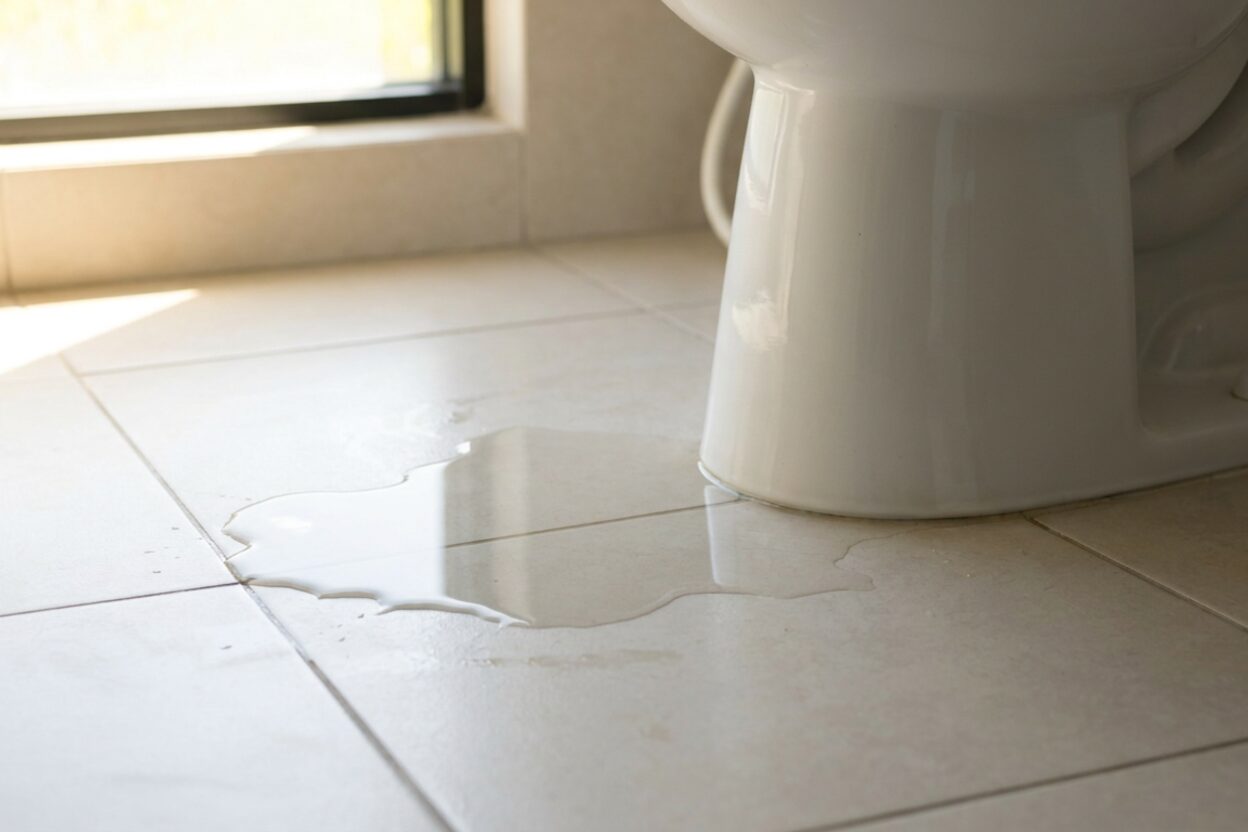
Water Around Toilet Base? Here's Why & How to Fix It

Why Does Water Keep Appearing Around My Toilet Base?
Read full question
My maintenance team flagged a water issue at one of the units — there's a small but persistent puddle forming around the base of the toilet, and I'm trying to narrow down the cause before I send someone in to fix it. The building's maintenance guide says the toilet was recently reseated with a new wax ring, so that should rule out a failed seal — but the water keeps coming back regardless.
What's throwing me off is that the manual points to the wax ring as the default culprit for base leaks, yet I'm not sure that's actually what's happening here given the recent work. I need to figure out whether we're dealing with a condensation issue, a loose connection somewhere, or something else entirely before authorizing a full toilet pull.
Quick Answer
The most likely culprit for water at the toilet base is either a loose tank-to-bowl connection, a dripping supply line, tank condensation, or a failed wax ring seal — in roughly that order of likelihood. Before pulling the toilet, rule out the simpler fixes first. Check connections, timing, and whether the water appears only after a flush or constantly.
Start Here: The Most Likely Fix Is Simpler Than a Wax Ring
Water at the base of a toilet is a frequent call in property maintenance, and the good news is that a failed wax ring — while a real possibility — is often not the first thing to blame. Several simpler, faster-to-fix causes should be ruled out first. Here's how to work through them in a logical order.
Step One: Watch When the Water Appears
Timing is your single biggest diagnostic clue. Ask the tenant (or observe yourself) to answer two questions: Is the water there even when the toilet hasn't been flushed in a while? And Does it appear or get worse right after a flush?
- Water only after flushing: Points toward the wax ring seal or a loose closet bolt letting wastewater escape at the base on each flush. This water may have a slight odor.
- Water present without flushing, or worse on humid days: Strongly suggests tank condensation (sweating) dripping down and pooling at the floor. This water will be clean and odorless.
- Constant, slow seep regardless of flushing: Check the supply line and shutoff valve connection first — these are common and easy to overlook.
Check These Three Things Before Touching the Wax Ring
1. The Supply Line and Shutoff Valve
Crouch down and dry the area with a towel, then run your hand along the supply line from the shutoff valve up to the fill valve connection at the bottom of the tank. Even a slow drip at either fitting can run down and pool at the base, making it look like a base leak. Tighten any loose fittings by hand first, then snug them slightly with an adjustable wrench — don't overtighten, as these fittings can crack. If the supply line itself feels stiff, brittle, or shows mineral buildup, replacing it is inexpensive and straightforward.
2. Tank Condensation
In humid conditions, or when cold water fills a tank in a warm bathroom, the outside of the porcelain tank can sweat heavily — enough to drip onto the floor and create a convincing puddle at the base. Wipe the tank dry and check again in an hour without flushing. If moisture reappears on the outside of the tank, condensation is your answer. Improved bathroom ventilation usually addresses this; some older tanks were fitted with an insulating foam liner inside — if yours has one and it has deteriorated, it may be less effective, though improved ventilation is the more common and reliable fix for condensation.
3. Tank Bolts and the Tank-to-Bowl Gasket
The rubber gasket between the tank and bowl, along with the two tank bolts, can loosen or degrade over time. Water leaking here drips down the back of the bowl and can pool at the base. Check the bolts by gently trying to wiggle the tank — any movement warrants tightening. Tighten the bolts finger-snug, then a quarter turn at a time, alternating sides. Do not overtighten on porcelain.
If It's Happening Right After Every Flush — Then Consider the Wax Ring
If you've ruled out the above and the water appears only during or immediately after flushing, has any odor, or you can see the toilet rocking even slightly, a compromised wax ring or loose closet bolts become the leading suspect. Water with a sewage odor may also indicate sewer gas escaping through a failed seal — sewer gas can be a health and safety concern. If the smell is persistent or strong, ventilate the space and prioritize the repair; if tightening closet bolts does not resolve it, call a licensed plumber. A toilet that rocks even a little will work the wax ring loose over time, so check the closet bolts at the base first. Remove the plastic caps at each side of the toilet base and try to snug the nuts — again, quarter turns alternating sides, and stop before the porcelain base cracks. If the toilet rocks even after tightening, the flange may be damaged.
If tightening the closet bolts doesn't stop the rocking and the leak persists after a flush, pulling and reseating the toilet with a new wax ring (or wax-free alternative) is the right call. Toilet bowls are heavy — typically 60 lbs or more — and awkward to lift. Have a second person help with the pull and reset to protect your back and avoid dropping the porcelain. For more on that process, see our wax ring and flange guides.
When to Call a Licensed Plumber
Some situations go beyond a straightforward DIY fix. Stop and call a plumber if you find:
- The flange is cracked, broken, or sits below the finished floor level
- The water has an odor and the closet bolts are already snug — sewer gas may be escaping; the flange seal likely needs repair or replacement by a licensed plumber
- Other drains in the unit are also slow or backing up (this points to a main-line issue, not the toilet itself)
- There's any sign of a cracked bowl or tank
A Note on Caulking the Base
Once the leak is resolved, you may face a caulking decision. Many plumbing codes require the toilet to be caulked to the floor for sanitation reasons and to prevent the base from shifting. However, some experienced plumbers deliberately leave the rear of the base un-caulked so that any future wax ring failure shows up as visible water on the floor rather than seeping under the base undetected. Both approaches have merit — check your local plumbing code for what's required in your jurisdiction and make the call accordingly.
Tools and Supplies to Have on Hand
For this diagnosis and most of the fixes above, you'll want:
- Adjustable wrench and channel-lock pliers
- Old towels or rags (and a small bucket)
- A sponge for drying the area thoroughly before inspecting
- Replacement supply line (braided stainless is a reliable choice)
- New wax ring or wax-free seal if a reseat becomes necessary
- Replacement closet bolts if the existing ones are corroded
Working systematically from the simplest causes outward will save time and avoid unnecessary work. In many cases the fix turns out to be a snug fitting or a new supply line rather than a full toilet pull.
 Eastman 12 Inch Flexible Toilet Connector, 7/8 Inch Ballcock x 3/8 Inch Compression, Stainless Steel Braided Hose, 48088
View on Amazon →
Eastman 12 Inch Flexible Toilet Connector, 7/8 Inch Ballcock x 3/8 Inch Compression, Stainless Steel Braided Hose, 48088
View on Amazon →
 Korky 6000BP Universal Toilet WaxFree Seal with Hardware - Toilet Installation Made Easy - Made in USA , Red
View on Amazon →
Korky 6000BP Universal Toilet WaxFree Seal with Hardware - Toilet Installation Made Easy - Made in USA , Red
View on Amazon →
 2 PCS Toilet Floor Bolts and Caps Closet, Universal Toilet Bowl to Floors Bolt Kits Stainless Steel Toilets Fixing Bolts and Nuts Set Toilets Closet Bolt Set with Washers and Cover Cap Decorative
View on Amazon →
2 PCS Toilet Floor Bolts and Caps Closet, Universal Toilet Bowl to Floors Bolt Kits Stainless Steel Toilets Fixing Bolts and Nuts Set Toilets Closet Bolt Set with Washers and Cover Cap Decorative
View on Amazon →

Still need help? Ask a Plumbing Expert AD
Get a personalized answer from a verified plumbing expert. Describe your issue and get step-by-step help.